
Blog
Abuse Shield: Centralised Server Protection Against AI-Driven Attacks
Cybercrime has become cheap, and that changes the threat modelFor years, reconnaissance was the slow part of an attack. Mapping a target's public foot...
Cybercrime has become cheap, and that changes the threat model
For years, reconnaissance was the slow part of an attack. Mapping a target's public footprint, cross-referencing social profiles, guessing which employee handles which system: it took patience, specialist tools and a certain amount of skill. That bottleneck has largely disappeared. AI-assisted tooling now sweeps public sources at machine speed, links fragments of information to real people and organisations, and drafts convincing messages from what it finds. The barrier to entry has fallen sharply, and the consequence is uncomfortable but simple: if attacks become cheaper, the pool of viable targets widens.
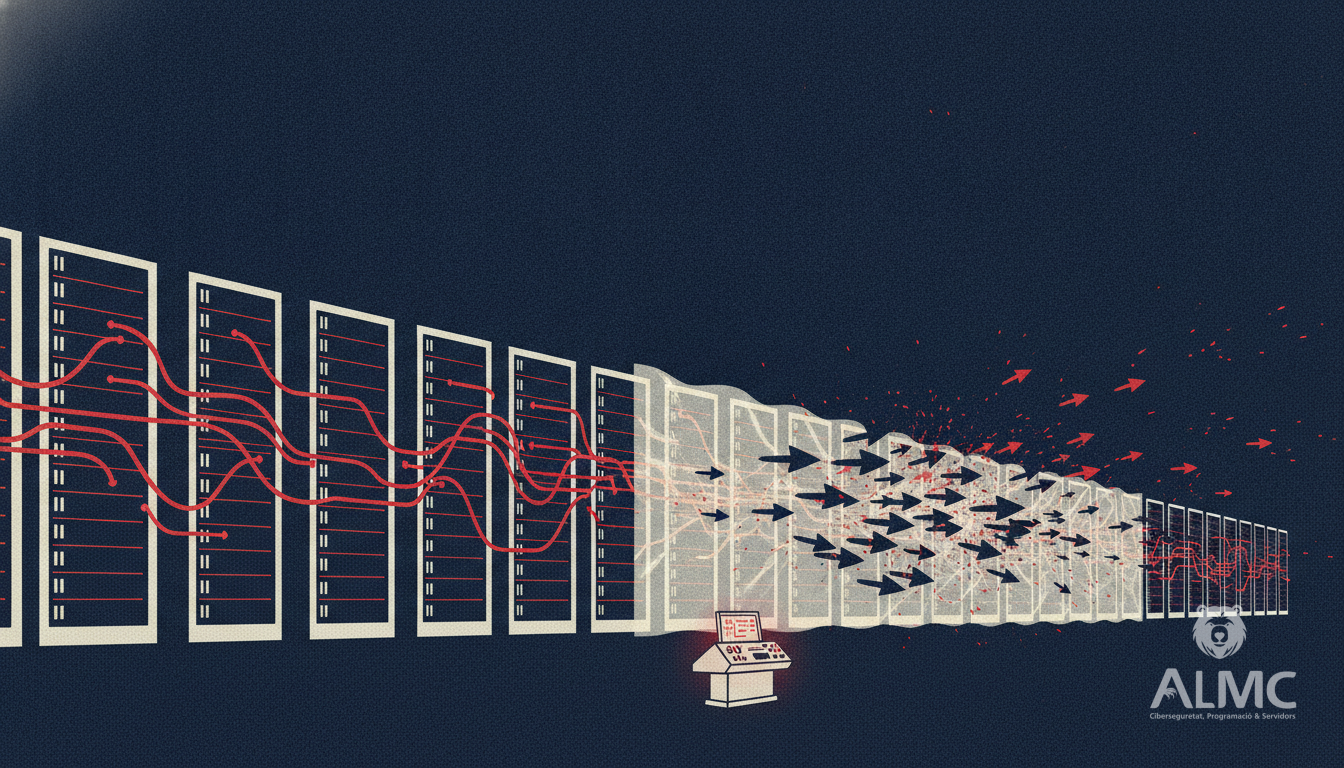
For a systems administrator in Barcelona or a hosting company in Lleida, this shifts the question. It is no longer only about whether your perimeter is patched. It is about how quickly and consistently you react when thousands of automated probes, credential-stuffing attempts and scripted exploits start hammering every machine you run.
Why perimeter defences alone no longer hold
Most small and mid-sized organisations already run some form of intrusion prevention. The problem is rarely the tool itself; it is the way it is deployed. A typical estate looks like this:
- One firewall rule set configured months ago and never revisited.
- fail2ban installed on some servers but not others, with hand-tuned jails that differ from machine to machine.
- Logs scattered across hosts, so a pattern visible across the fleet stays invisible on any single box.
- No shared memory: an IP banned on the web server is still free to attack the mail server ten minutes later.
Attackers exploit exactly this fragmentation. They rotate source addresses, spread attempts across services and rely on the fact that each server judges them in isolation. A single machine may see two failed logins and do nothing; the fleet as a whole may have seen two thousand.
What Abuse Shield does differently
Abuse Shield is built around a straightforward idea: protection should be a property of your infrastructure, not of each individual machine. Instead of configuring fail2ban separately on every host, you manage it centrally across all your servers, and every ban decision feeds a reputation feed shared between them.
In practice, that means three things:
- Automatic blocking of malicious IPs. Suspicious behaviour is detected and blocked without waiting for an administrator to notice, whether the source is a brute-force attempt, a probing script or a known abusive range.
- Managed fail2ban across multiple machines. Jails, thresholds and exclusions are defined once and applied consistently, so a server commissioned last week is protected to the same standard as one running for years.
- A shared reputation feed. When one of your servers identifies an abusive address, the rest of the fleet learns about it. The attacker's first attempt against any host becomes their last against all of them.
The effect compounds. Each additional server strengthens the collective picture rather than adding another isolated silo, which is precisely the opposite of how fragmented setups behave.
Built for the way Spanish SMEs and hosts actually operate
This matters most in environments where a small team carries a large estate. A regional hosting provider running customer virtual machines in a data centre near Tarragona cannot afford to hand-tune jails on every node, and cannot afford the reputational damage of one compromised tenant spraying attacks across the network. A pyme with its own servers, an ERP and an e-commerce platform has the same problem at smaller scale: three or four machines, one administrator, no dedicated security team.
Centralisation also helps with accountability. Under GDPR, a personal data breach can trigger notification obligations and, in serious cases, significant administrative fines. Being able to demonstrate that access attempts are logged, that abusive sources are blocked systematically and that protective measures are applied uniformly across systems is a meaningful part of the technical and organisational measures a controller is expected to maintain. Abuse Shield does not replace that governance work, but it makes the technical layer consistent and auditable rather than improvised.
Costs are predictable in euros and scale with the number of servers rather than with the volume of attacks, which is important when a campaign can generate enormous traffic at almost no cost to the attacker.
Practical steps to pair with the tooling
Technology alone will not close the gap opened by cheaper, AI-assisted attacks. A few habits reinforce it considerably:
- Reduce your public footprint: audit what your organisation publishes about infrastructure, staff roles and internal tooling.
- Enforce multi-factor authentication on every administrative interface, including hosting panels and mail.
- Segment management networks so that a compromised web server cannot reach the control plane.
- Review ban lists and reputation feeds periodically for false positives, especially where shared hosting or NAT is involved.
- Train staff to treat unsolicited, oddly well-informed messages as suspicious by default, because that is exactly what they now are.
The underlying shift is one of economics. When reconnaissance and social engineering become inexpensive, defence has to become systematic. Centralising fail2ban, automating IP blocking and sharing reputation across every server you run is one of the most direct ways to raise the cost again, on your side of the equation.
Related
- How to Harden Your Servers with Fail2ban and IP Reputation Feeds
- Fail2ban: Your First Line of Defense Against Unauthorized Server Access
- Critical libssh2 flaw: urgent patch for SSH servers
- Desarrollo web
Put these ideas into practice
Talk to ALMC about a solution for your business. Explore your options or contact our team.