
Blog
Server Security: Centralised IP Blocking with Abuse Shield
Why scattered defences leave gapsMost organisations running their own infrastructure end up in the same place: a handful of machines, each with its ow...
Why scattered defences leave gaps
Most organisations running their own infrastructure end up in the same place: a handful of machines, each with its own firewall rules, its own fail2ban configuration and its own idea of who is welcome. It works, until it does not. One server gets hammered by a credential-stuffing campaign, the administrator blocks the offending addresses there, and the same attackers simply move to the next machine in the rack, which knows nothing about what just happened next door.
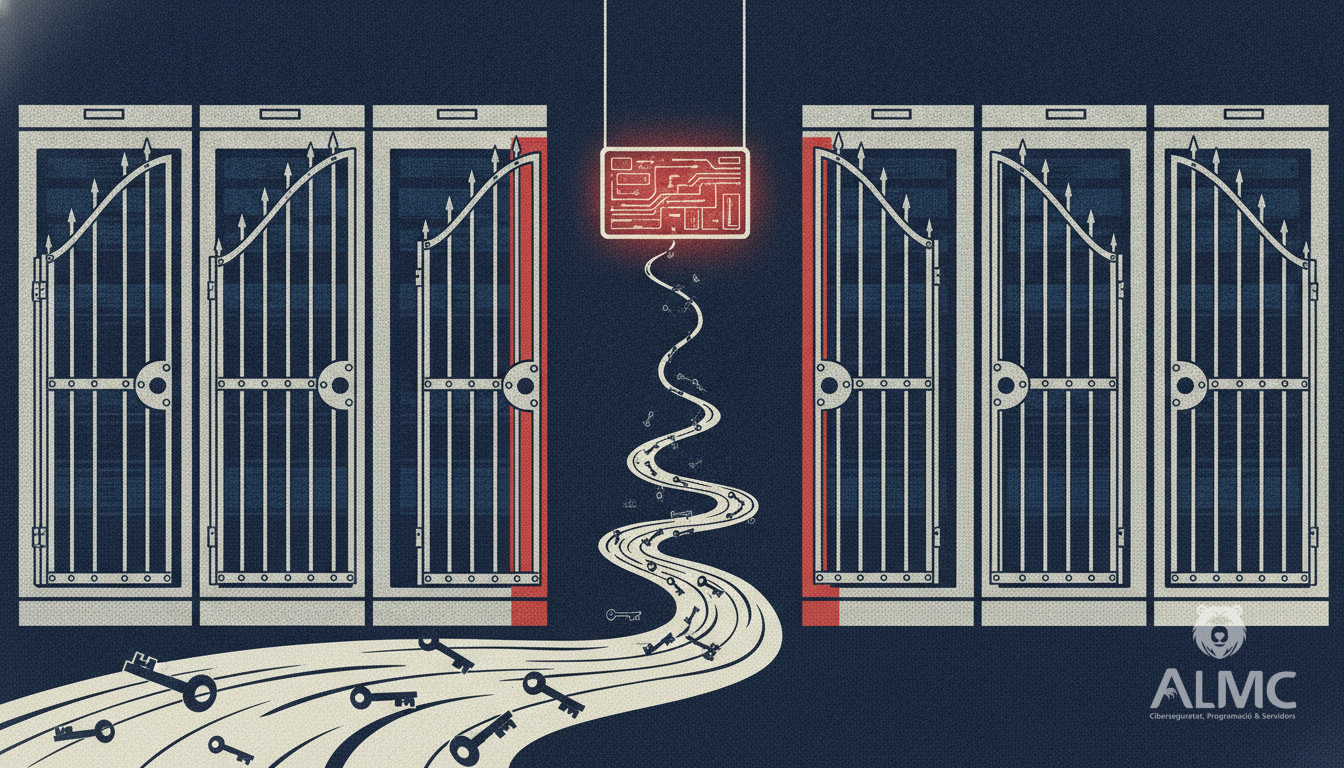
This is the quiet inefficiency at the heart of many small and mid-sized IT setups in Catalonia. A company in Lleida with three application servers, a mail relay and a couple of VPS instances in Barcelona may be running five independent security postures. Each one is a silo. Each one learns slowly, and none of them shares what it has learned.
Abuse Shield was built to close that gap. Instead of treating every machine as an island, it centralises protection so that a threat detected on one server becomes intelligence for all of them.
What centralised protection actually means
The idea is straightforward, even if the plumbing behind it is not. Abuse Shield brings three capabilities together under one roof:
- Automatic blocking of malicious IP addresses. Rather than waiting for an administrator to notice a flood of failed logins or abusive requests, the system identifies hostile behaviour and applies blocks without human intervention.
- Managed fail2ban across multiple machines. fail2ban remains an excellent tool, but managing it by hand on ten servers is tedious and error-prone. Abuse Shield handles the configuration and keeps every instance aligned, so policies do not drift apart over time.
- A shared IP reputation feed. When one server identifies an address as malicious, that verdict is published to a common feed. Every other server subscribed to it can act on that knowledge immediately, even before the attacker knocks on its door.
The result is a network that behaves like a single organism rather than a collection of strangers. The first server to be probed effectively warns all the others.
Who benefits most
Three profiles tend to feel the difference quickly. System administrators gain back the hours spent SSH-ing into machines to tweak jail configurations and reconcile inconsistent rules. Hosting companies, which may run dozens or hundreds of customer servers, get a uniform baseline of protection that is far easier to audit and to explain to clients. And small businesses with their own servers, often without a dedicated security team, get enterprise-style coordination without the operational overhead.
For a hosting provider in Tarragona or Girona, the shared reputation feed is particularly valuable. Attack traffic rarely targets a single tenant; it sweeps across ranges. When one customer's server reports an abusive source, the whole fleet can pre-emptively refuse it. That reduces noise, lowers load and shortens the window in which an attacker can operate.
Fail2ban, but without the babysitting
fail2ban is one of those tools that rewards careful tuning and punishes neglect. Default jails catch the obvious cases, but real environments need custom filters, sensible ban durations and a clear view of what is being blocked and why. Multiply that by every machine you operate and the maintenance burden grows faster than the fleet.
Managed fail2ban removes that burden. Policies are defined once and applied consistently. Bans are visible in a single place rather than scattered across log files on different hosts. When you need to whitelist a partner's address or adjust a threshold, you do it centrally instead of repeating the change machine by machine and hoping nothing was missed.
Reputation as a shared asset
The most interesting part of the model is the reputation feed. Individually, each server sees only a slice of the traffic directed at it. Collectively, they see a much broader picture. An address that probes one host today may attack another tomorrow, and a shared feed turns that pattern into a defensive advantage.
This is not about blacklisting innocent parties. Reputation systems work best when they are curated, transparent and reversible, so that a false positive can be corrected quickly. The value lies in shortening the time between detection and protection, and in making sure that knowledge does not die with the machine that discovered it.
Practical steps before you centralise
If you are considering consolidating your defences, a few preparatory moves make the transition smoother:
- Inventory every server and note which ones currently run fail2ban, and with what configuration.
- Identify legitimate high-traffic sources, such as monitoring probes, backup agents or partner integrations, so they can be whitelisted from the outset.
- Review log retention and access policies, keeping GDPR principles in mind: collect what you need, keep it no longer than necessary, and restrict who can see it.
- Decide on a sensible default ban duration and escalation policy, then apply it uniformly.
- Document an escalation path for false positives, so a blocked customer or partner can be unblocked without delay.
None of this requires a large team. It requires a decision to stop treating each server as a separate problem.
A quieter, more predictable infrastructure
The appeal of centralised protection is not only security. It is calm. When blocking is automatic, fail2ban is managed and reputation is shared, administrators spend less time firefighting and more time on the work that actually moves the business forward. Servers stop being a source of low-level anxiety and start behaving like a coordinated system.
For organisations across Catalonia running their own infrastructure, whether a single rack in Lleida or a distributed estate spanning several provinces, that coordination is the difference between reacting to incidents one machine at a time and preventing them across the board.
Related
- How to Harden Your Servers with Fail2ban and IP Reputation Feeds
- Fail2ban: Your First Line of Defense Against Unauthorized Server Access
- Critical libssh2 flaw: urgent patch for SSH servers
- Desarrollo web
Put these ideas into practice
Talk to ALMC about a solution for your business. Explore your options or contact our team.